
Author: Site Editor Publish Time: 03-11-2025 Origin: Site


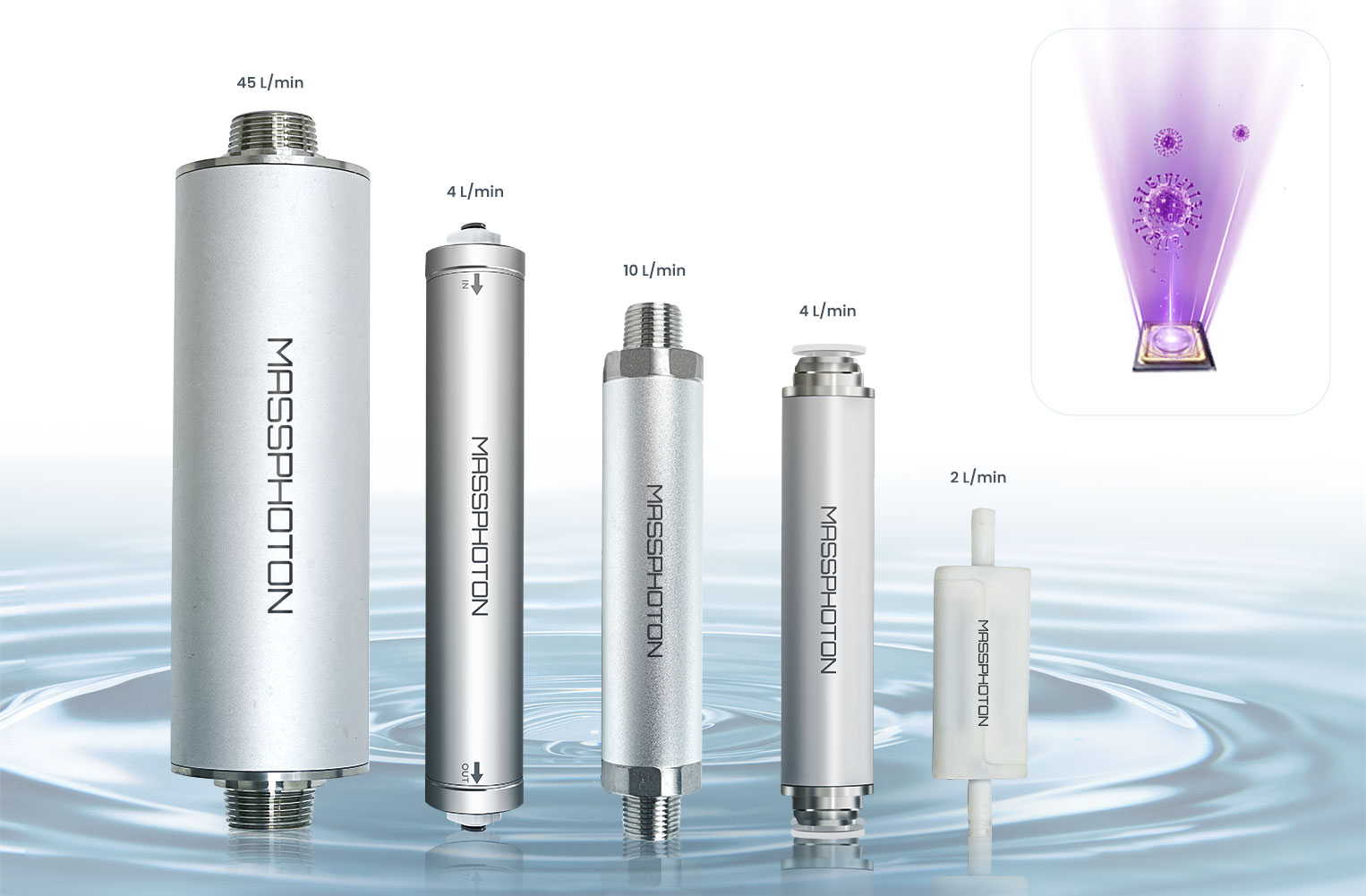
In today’s pursuit of healthy drinking water, ultraviolet (UV) water disinfection technology has gained widespread acclaim for its ability to disinfect without introducing chemical agents or causing secondary pollution. Among the latest innovations, deep ultraviolet light-emitting diodes (UV-C LEDs) are emerging as an ideal replacement for traditional mercury-vapor UV lamps. UV-C LED-based disinfectors offer distinct advantages, including compact size, instant start-up, and environmental friendliness (mercury-free). However, the true heart of an efficient UV-C LED water disinfector lies not solely in the tiny semiconductor chips emitting germicidal short-wavelength light, but rather in the invisible "dance" within the device—the sophisticated fluid dynamics design. It is precisely this choreographed interplay between light and flow that ensures every droplet of water receives a sufficient UV dose to effectively inactivate microorganisms.
I. Fundamental Principle: The UV Dose Law
To fully appreciate the critical role of fluid dynamics in UV-C LED water disinfectors, one must first understand the "golden rule" of UV disinfection: **UV dose**. UV dose is typically measured in millijoules per square centimeter (mJ/cm²) and is defined as:
UV Dose (D) = UV Irradiance (I) × Exposure Time (T)**
Here, irradiance (I) refers to the UV power incident per unit area (mW/cm²), which is influenced by the UV-C LED’s output power, optical system design, and the water’s UV transmittance. Exposure time (T) denotes the duration (in seconds) that a water element remains within the effective UV irradiation zone. Extensive academic research and experimental data show that effective inactivation of common pathogens—such as *E. coli*, *Legionella*, and even viruses—generally requires a UV dose in the range of **20–40 mJ/cm²**. Insufficient dose fails to adequately damage microbial DNA or RNA, rendering disinfection ineffective. Numerous studies have precisely quantified the required UV doses for various microorganisms, further validating the scientific basis and efficacy of this dose range.
II. The Critical Role of Fluid Dynamics: From Non-Uniformity to Homogenization
In a static, ideal scenario, calculating UV dose is relatively straightforward. However, in real-world dynamic flow conditions, the situation becomes highly complex. The motion of water within the disinfection chamber directly determines the actual UV dose received by each microorganism. The core objective of fluid dynamics design is to optimize the flow field—ensuring that all fluid parcels (potentially carrying microbes) experience **nearly identical exposure times** and are **maximally exposed to sufficient irradiance**. To achieve this, the design must address several key fluid dynamic challenges:
1. Mitigating “Short-Circuiting” and “Dead Zones”
Poorly designed inlet and outlet geometries can cause a portion of the flow to take the shortest possible path through the irradiation zone—a phenomenon known as **“short-circuiting.”** Water in these streams receives minimal UV exposure, often far below the required dose, leading to incomplete disinfection. Conversely, certain corners or regions of the chamber may become **“dead zones,”** where water stagnates. While microbes in these zones may be over-irradiated, the overall system efficiency is significantly reduced due to wasted hydraulic capacity.
To counter this, engineers employ **Computational Fluid Dynamics (CFD)** simulations to optimize chamber geometry. For example, a **tangential inlet** design induces a swirling flow upon entry, forcing water to spiral along the chamber wall. This approach not only increases the effective flow path length but also enhances mixing between faster and slower streamlines, drastically reducing both short-circuiting and dead zones. Studies have demonstrated that such optimized swirl-flow designs can **improve disinfection efficiency by over 30%**.
2. Disrupting the “Laminar Boundary Layer”
In laminar flow, water moves in parallel layers, with the highest velocity at the center and near-zero velocity at the wall adjacent to the UV-C LED’s quartz sleeve—creating a **boundary layer**. Microbes within this boundary layer are closest to the UV source and thus experience high irradiance, but their extremely slow movement may lead to unnecessary overexposure. Meanwhile, microbes near the center travel faster but are farther from the light source, receiving insufficient irradiance for effective inactivation.
To overcome this, **turbulent flow** is intentionally introduced. Designers incorporate **turbulence promoters**—such as static mixers, baffles, or surface roughness features—into the chamber. Turbulence generates chaotic eddies that continuously mix fluid from the core and near-wall regions. As a result, microbes that previously "hid" in the center are rapidly transported to high-irradiance zones near the LEDs. This dynamic mixing **homogenizes the UV dose distribution** across the flow field. Experimental data consistently shows that, at identical flow rates, turbulent flow achieves **significantly higher microbial inactivation rates** than laminar flow.
3. Aligning the Irradiance Field with the Flow Field
The spatial distribution of UV irradiance from a UV-C LED array is inherently non-uniform—typically strongest at the center and weaker toward the periphery. If the flow field is not aligned with this irradiance profile, UV energy is wasted in low-flow regions, while high-flow zones may receive inadequate dose.
Cutting-edge design strategies now involve **tight coupling of optical and CFD simulations**. Engineers perform precise optical modeling of the LED array’s irradiance field and overlay it with the 3D simulated flow field. This allows them to strategically position and orient LEDs—much like a conductor orchestrating an ensemble—so that **high-irradiance zones coincide precisely with regions of highest flow probability**. For instance, LEDs can be arranged to create a high-intensity “plane” that the flow must actively **pass through**, rather than merely **glance past**.
III. The Power of Quantitative Design: Computational Fluid Dynamics (CFD)
Modern UV-C LED disinfector development is inseparable from CFD. By constructing a 3D model of the disinfection chamber, CFD enables visualization of **streamlines, velocity contours, and particle residence time distributions**. Engineers can iteratively adjust geometric parameters—such as chamber aspect ratio, baffle angles, or inlet curvature—and conduct rapid “virtual experiments” to identify designs that deliver the **most uniform residence time distribution** and **highest UV dose efficiency**. This approach dramatically accelerates R&D while reducing prototyping costs.
Conclusion
A UV-C LED water disinfector is far more than a simple “light tube plus pipe.” It is a **highly integrated system** merging optics, microbiology, electronics, and—critically—fluid dynamics. Fluid dynamics serves as the **silent structural backbone** that ensures reliable, high-performance operation. By meticulously shaping and guiding the flow of water, it transforms an inherently chaotic and unpredictable fluid motion into a **disciplined, optical ritual**—where every microorganism is guaranteed its share of lethal UV exposure.
Looking ahead, as UV-C LED electro-optical efficiency continues to improve and multi-physics simulation tools become ever more refined, the harmony between light and flow will only grow more elegant and effective—providing stronger technological assurance for global drinking water safety.


