Author: Site Editor Publish Time: 22-01-2026 Origin: Site


Ultraviolet (UV) radiation, invisible light with wavelengths ranging from 100 to 400 nm, is traditionally categorized into three bands: UVA (315–400 nm), UVB (280–315 nm), and UVC (200–280 nm). Among these, UVB and UVC hold the highest application value in biological effects and disinfection engineering.
In the biomedical field, UV radiation is utilized for dermatological phototherapy, disinfection of blood products, and medical environment control. In water treatment, UV disinfection has become a globally recognized, highly efficient technology for drinking water and reclaimed water treatment that produces no chemical by-products. Although the targets and objectives differ, the core scientific foundation remains highly consistent: the dose-response relationship.
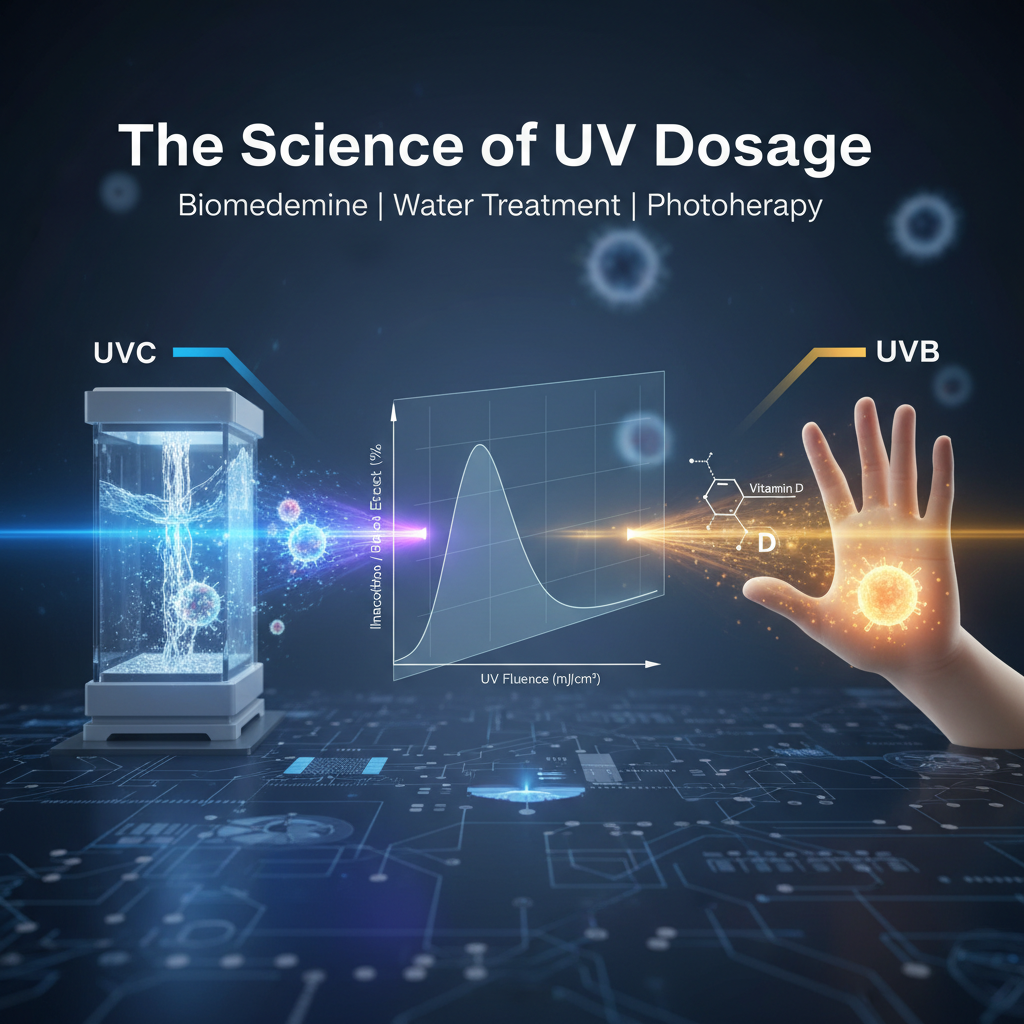
To understand this principle, two key terms must be defined:
UV Dose (Fluence): Refers to the radiant energy received per unit area by the irradiated object. The formula is:
Dose (mJ/cm²) = Irradiance (mW/cm²) × Exposure Time (s).
The international standard unit is millijoules per square centimeter (mJ/cm²), also commonly referred to as "Fluence."
Effect: Refers to the observable changes produced after dose exposure, such as microbial inactivation, cell apoptosis, DNA damage, or Vitamin D synthesis.
The core logic of the dose-response relationship is that, within a certain range, the intensity of the effect changes non-linearly with the increase in dose, exhibiting clear thresholds, effective windows, and saturation points. This relationship is modulated by factors such as the characteristics of the target (e.g., microbial species, cell type) and environmental conditions (e.g., water quality, temperature), forming the scientific basis for the precision application of UV technology.
(1) Medical Disinfection and Microbial Inactivation (UVC)
UV applications in medicine are primarily divided into sterilization and phototherapy, both of which rely heavily on precise dose control.
Different pathogens exhibit significantly different sensitivities to UV. For instance, the dose required for a 2-log (99%) inactivation of Escherichia coli (E. coli) is only 4–6 mJ/cm² [1], while the 4-log (99.99%) inactivation dose is approximately 12–16 mJ/cm² [2, 3].
In water treatment, the core goal of UV disinfection is the inactivation of pathogenic microorganisms, where the dose-response relationship is even more strictly quantified [1]:
| Microorganism | 3-log (99.9%) Inactivation Dose (mJ/cm²) |
| Cryptosporidium | 10 – 12 |
| Giardia | 8 – 12 |
| Adenovirus (HAdV-2/5) | 90 – 120 |
(2) The Dose-Window Effect in Phototherapy (UVB)
In dermatology, Narrowband UVB (311–313 nm) is the mainstream treatment for psoriasis and vitiligo. Its efficacy and safety depend entirely on dose management:
Erythema Dose (MED / SED)
1 SED ≈ 100 J/m² (Effective Erythemal UV).
This is not equivalent to a fixed mJ/cm² value; it must be calculated using a spectral weighting function [4] (CIE Erythema Action Spectrum).
Dose-Response Characteristics of Vitamin D Synthesis
Research [5, 6] indicates:
0.5–1.5 SED: Significant increase in 25(OH)D levels.
> 2 SED: Synthesis efficiency reaches a plateau.
> 3 SED: Risk of erythema and DNA damage increases significantly.
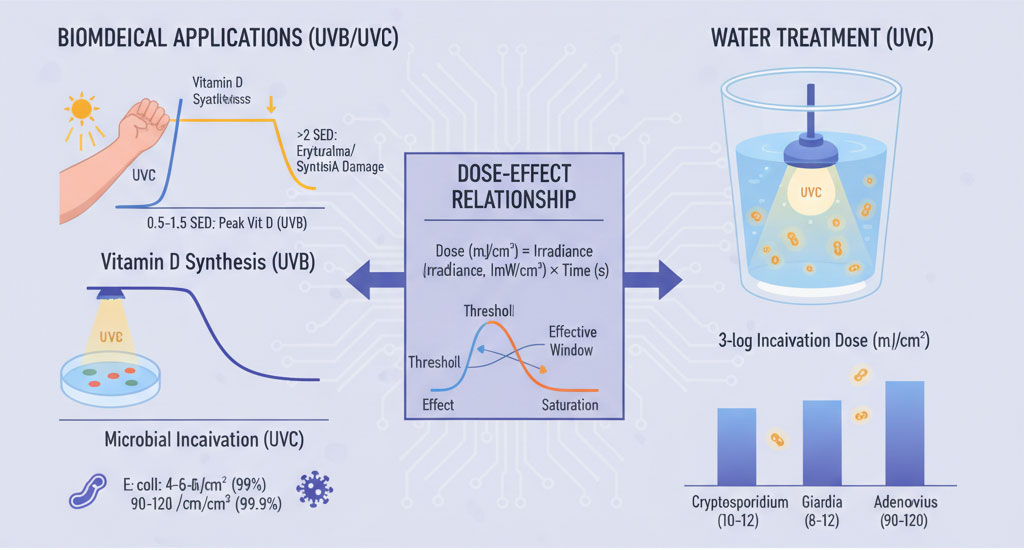
In summary, although UV radiation is applied in different scenarios within the biomedical and water treatment sectors, both strictly follow the core scientific law of the dose-response relationship. In medical disinfection, UVC inactivation efficiency varies significantly across microorganisms—E. coli requires only 4–6 mJ/cm² for 99% inactivation, whereas highly resistant viruses like Adenovirus require 90–120 mJ/cm². In phototherapy, the biological effects of UVB exhibit a distinct "dose window": 0.5–1.5 SED effectively promotes Vitamin D synthesis, benefits saturate beyond 2 SED, and risks of erythema and DNA damage rise sharply beyond 3 SED. Notably, the SED (Standard Erythema Dose) is not a fixed energy value but a biologically effective dose weighted by the CIE erythema action spectrum, reflecting the spectral dependence of UV effects. Collectively, these data demonstrate that precise dose control is the critical prerequisite for achieving safe, efficient, and differentiated applications of UV technology.
References:
USEPA., Ultraviolet Disinfection Guidance Manual. 2006.
Malayeri, A.H.E.A., Fluence (UV Dose) Required to Achieve Incremental Log Inactivation of Bacteria, Protozoa, Viruses and Algae – A Critical Review. IUVA News, 2016. 18(1), 4–15.
Bolton, J.R.C.C., The Ultraviolet Disinfection Handbook. 2011: AWWA.
IEC 62471:2006 Photobiological safety of lamps and lamp systems.
Holick, M.F., N Engl J Med, 2007. 266–281(3).
Cashman, K.D.E.A., The impact of UV dose on cutaneous vitamin D synthesis: a systematic review. Am J Clin Nutr, 2019. 109(3), 698–709.