
Author: Site Editor Publish Time: 09-09-2025 Origin: Site


RO (Reverse Osmosis) water purification systems, with their high-precision filtration capability, can effectively remove heavy metals, antibiotics, scale, and other impurities from water, making them a preferred choice for many households. However, one critical issue is often overlooked: the storage tank and piping in RO systems can easily become breeding grounds for bacteria during long-term use. Even if the feed water has been thoroughly filtered, microbial contamination at the final stage still poses a risk to drinking water safety.
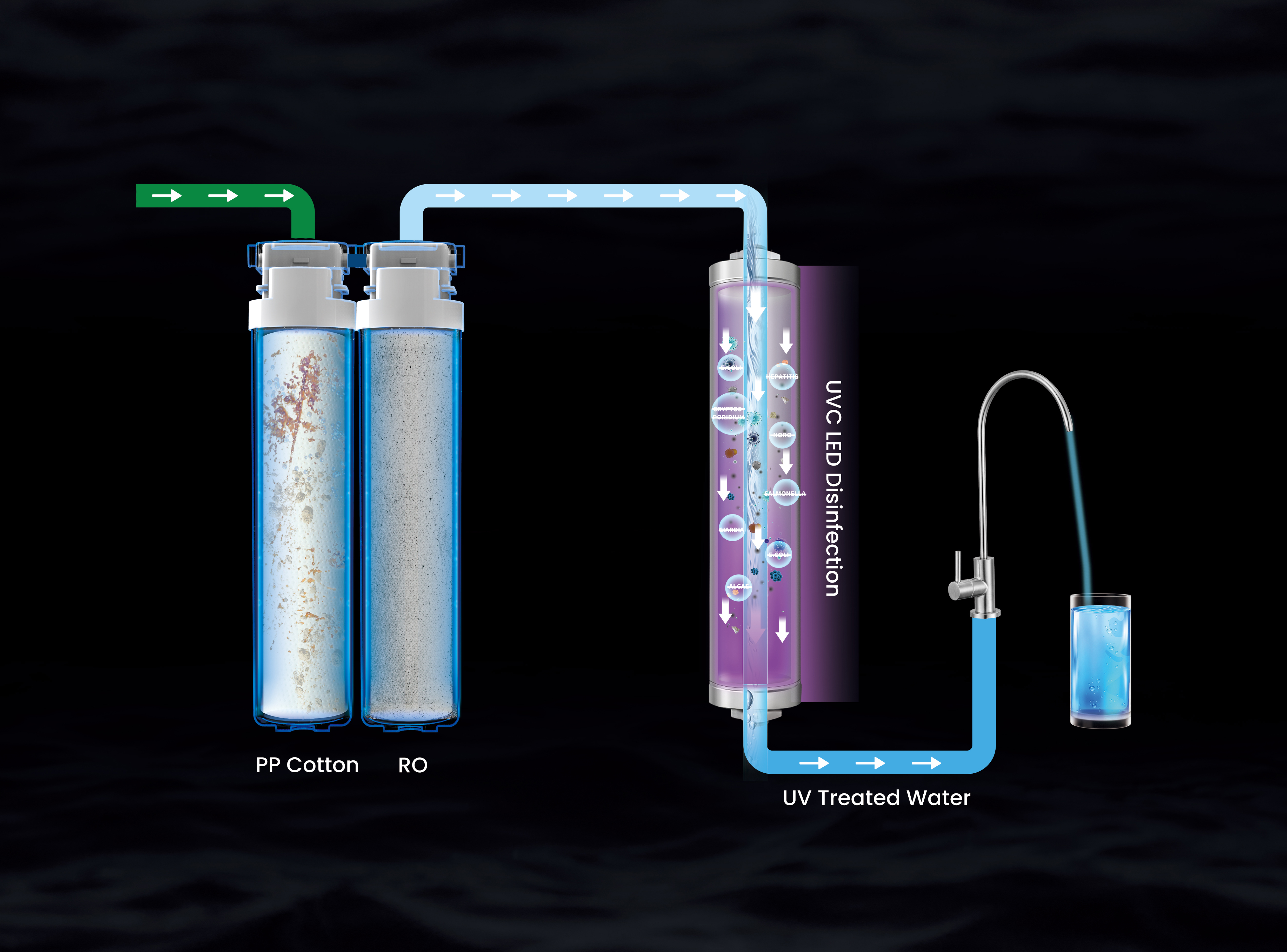
At this point, UVC LED (Deep Ultraviolet Light Emitting Diode) technology emerges as an “instant point-of-use” disinfection solution. With its efficiency, safety, and convenience, it is becoming the “last line of defense” for RO systems.
RO membranes can remove more than 99% of dissolved contaminants in water. However, ensuring safe drinking water requires protection across the entire process: filtration – storage – delivery – dispensing. In practice, the end components of RO systems (storage tank, piping, and faucet) present three major risks:
Secondary contamination in the storage tank: In systems with a pressure storage tank, water left unused for long periods (overnight or longer) creates a damp environment that can foster the growth of E. coli, Legionella, algae, and other microorganisms.
Bacterial biofilm in pipes: Prolonged contact between water and pipe walls, especially when materials age or cleaning is neglected, can lead to biofilm formation, which becomes a breeding ground for bacteria.
Faucet contamination: As the end point exposed to the environment, the faucet can introduce airborne microorganisms during operation. Over time, valve core gaps may allow external contaminants to infiltrate, compromising the purified water.
These problems mean that “purified water ≠ safe drinking water.” Traditional disinfection methods (such as ozone, silver ions, or mercury UV lamps) either leave residual risks or fail to meet the demand for “instant and safe water at the tap.” For example, mercury UV lamps require warm-up time and contain toxic mercury, while ozone leaves residuals that require dissipation. Neither satisfies the consumer’s demand for “turn on the tap and drink safely.”
UVC LEDs are deep-ultraviolet emitters based on semiconductor materials, operating within 200–280 nm. Their principle is to inactivate microorganisms by disrupting their nucleic acids (DNA/RNA). In RO systems, UVC LEDs offer three critical advantages:
Instant response – optimized for dynamic water use
UVC LEDs require no warm-up. Their response time is ≤100 ms. When the RO system detects water flow (via a flow sensor), the UVC LED module switches on instantly, disinfecting water as it flows. Once flow stops, the module shuts off automatically, minimizing energy waste and extending lifetime. This makes it ideal for both intermittent household use and high-frequency commercial applications (restaurants, offices), ensuring every batch of water is disinfected without delay.
High-efficiency inactivation – compliant with microbial standards
The germicidal effect of UV is wavelength-dependent. The 260–270 nm range is the “germicidal gold band,” as photons at this wavelength disrupt pyrimidine dimers in nucleic acids, preventing microbial replication. Lab results show that under conditions of ≤1.5 L/min flow and ≥30 mJ/cm² UV dose, UVC LEDs achieve >99.99% inactivation of E. coli (ATCC 25922), Staphylococcus aureus (ATCC 6538), and poliovirus (PV-1). Optimized flow cell designs (e.g., spiral irradiation chambers) ensure full water exposure, eliminating dead zones.
Safe and eco-friendly – designed for long-term use
UVC LED disinfection is purely physical, adding no chemicals and producing no harmful by-products. LEDs are mercury-free, eliminating environmental hazards associated with broken mercury lamps. Typical rated power is 3–5 W, with lifetimes ≥10,000 hours (equivalent to over 13 years at 2 hours daily use). This reduces operational costs and aligns with sustainability goals, making UVC LED solutions suitable for households, schools, and healthcare facilities.
At the faucet outlet: Embedding a UVC LED module inside the faucet, with coaxial alignment of the irradiation chamber and water channel, ensures direct exposure. Suitable for tankless RO systems.
At the storage tank outlet: Installing a UVC LED module between the tank outlet and piping ensures water is disinfected immediately upon leaving the tank. Suitable for systems with storage tanks.
In mid-piping sections: Adding a UVC LED unit at critical pipeline nodes (e.g., under-sink connections), using a T-joint structure for flexible integration in complex layouts.


Trigger stage: When the faucet is opened, the flow sensor detects water and sends a signal to the UVC LED controller.
Disinfection stage: The controller powers the UVC LED (typically 275 nm), disinfecting water flowing at controlled rates (via flow restrictor) for ≥1 second, ensuring sufficient dosage.
Shutdown stage: When the faucet closes, the system cuts power 1–2 seconds later, ensuring any residual flow is also disinfected while minimizing energy waste.
UV leakage protection: If the chamber is damaged or sealing fails, built-in UV sensors detect leakage and cut power immediately.
Dry-run protection: If the flow sensor malfunctions and the module activates without water, thermal protection (≥60℃) automatically shuts down the system to prevent overheating.
Secures drinking water safety: Acts as the final safeguard for true safe drinking.
Enhances user experience: Consumers no longer worry about stagnant water in pipes or tanks.
Drives brand differentiation: RO manufacturers can leverage “mercury-free + smart disinfection” to boost competitiveness.
Aligns with future trends: With global mercury bans advancing, UVC LEDs are set to become the industry standard.
UVC LED technology is redefining safety standards in RO water purification. With regulatory bans on mercury and ongoing cost reductions, what was once a “premium feature” is rapidly becoming the “industry standard,” building a reliable safeguard for the drinking water of millions worldwide.


