
Author: Site Editor Publish Time: 08-12-2025 Origin: Site


When discussing water quality assurance in homes or commercial spaces, "point-of-entry water treatment" and "point-of-use water treatment" are two frequently mentioned terms. With the rise of UVC LED (deep ultraviolet light-emitting diode) technology—a chemical-free, low-energy disinfection method that's gradually replacing traditional UV lamps—many people are puzzled: Should they choose a whole-house POE system or a POU device focused on specific scenarios? Today, we'll break down the core differences between the two and how UVC LED water purification enhances their advantages.
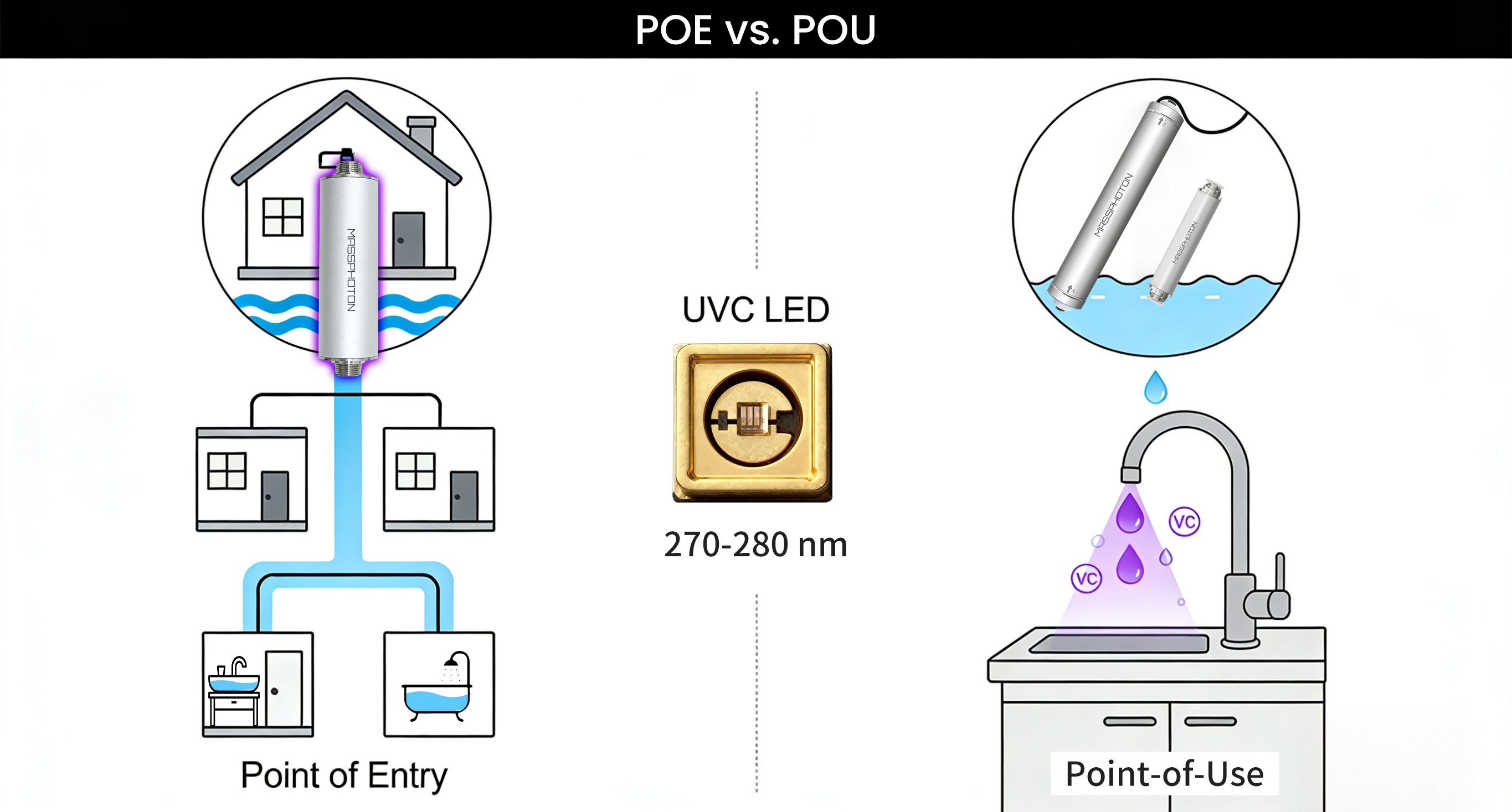
I. First, Understand: What Exactly Are POE water treatment and POU water treatment?
Before comparing them, let's clarify the core positioning of these two systems—their essential difference lies in the "scope and timing of water treatment."
1. POE (Point of Entry): Disinfection at Entry, the "First Line of Defense" for the Whole House
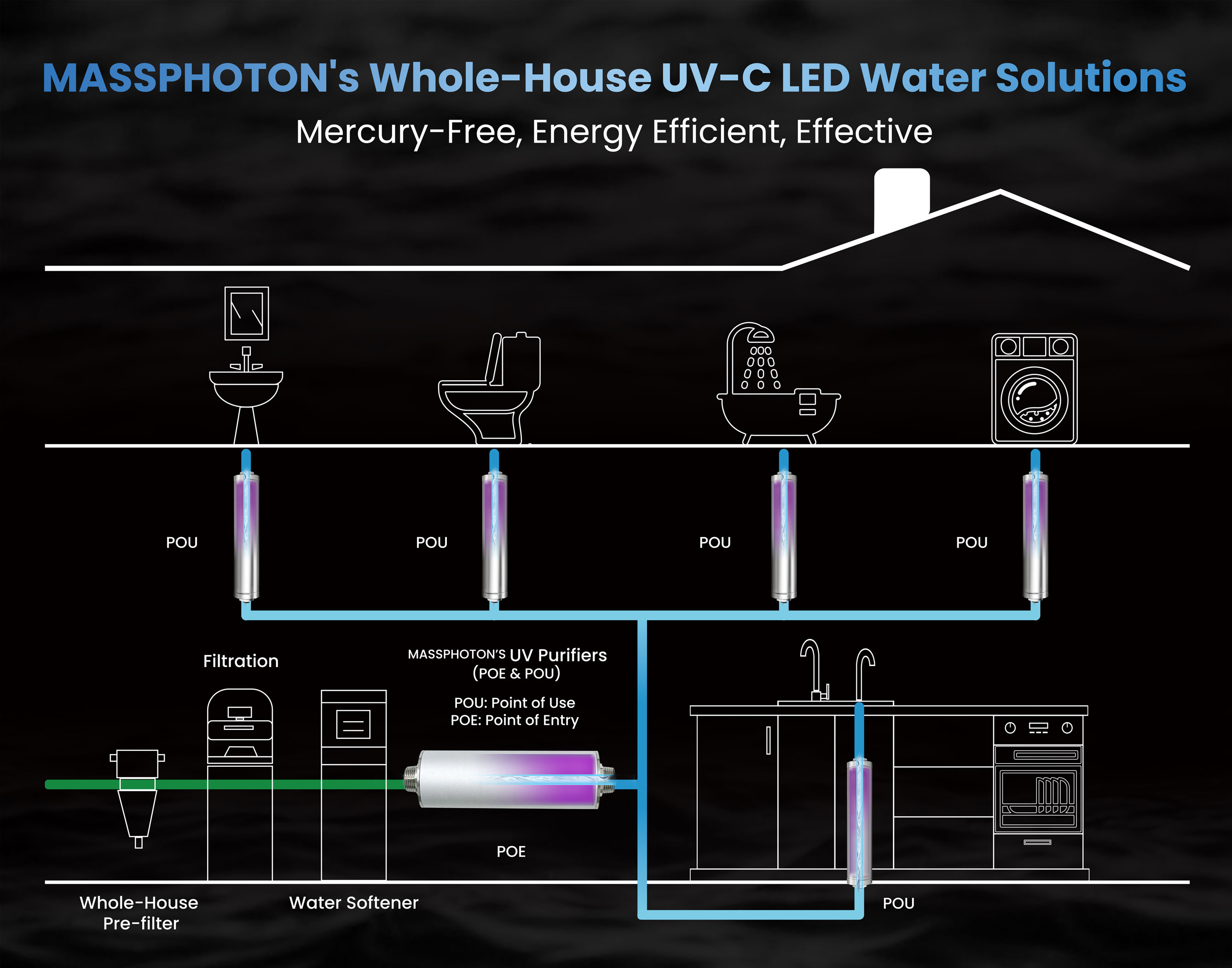
POE systems, also known as "point-of-entry water treatment systems," are typically installed on the main pipeline where tap water enters the building (e.g., after the water meter in homes or at the main inlet in commercial spaces). Their core function is to uniformly treat all water for the entire house or facility before it reaches individual usage points.
POE systems incorporating UVC LED technology usually embed a UVC LED disinfection module in the main pipeline—when water flows through, deep ultraviolet light (wavelength 260-280nm) disrupts the DNA/RNA of bacteria and viruses, achieving broad-spectrum disinfection (e.g., killing E. coli, COVID-19 virus, etc.). Additionally, some POE systems pair with pre-filtration (removing sediment, rust), forming a "filtration + disinfection" combination to ensure basic safety for all subsequent water uses (kitchen, bathroom, washing machine, humidifier, etc.).
2. POU (Point of Use): Precise Control at the End, Focused on "Key Scenarios"
POU systems, also known as "point-of-use water treatment systems," are installed near specific water usage points (e.g., under the kitchen faucet, bedside water dispenser, or infant room sink). Their core function is to provide precise, in-depth treatment tailored to the water needs of particular scenarios.
UVC LED technology is applied more flexibly in POU devices—for example, countertop purifiers, faucet direct-drinking machines, or infant-specific water dispensers often include miniaturized UVC LED modules. These devices typically first use RO reverse osmosis (removing heavy metals, antibiotics) or activated carbon filtration (improving taste), followed by UVC LED for the "final disinfection step," ensuring water quality meets higher standards for direct drinking, cooking, infant cleaning, and other scenarios.
II. Core Comparison: Understanding the Differences Between POE and POU in 5 Key Dimensions
Definitions alone aren't intuitive enough, so let's compare their applicable scenarios from a practical usage perspective using 5 key dimensions:
| Comparison Dimension | POE (Point-of-Entry Water Treatment System) | POU (Point-of-Use Water Treatment System) |
|---|---|---|
| Treatment Scope | Covers all water usage points throughout the entire house/facility | Targets only single or a few points (e.g., kitchen faucet, point of use water dispenser) |
| Core Functions | Broad-spectrum disinfection + basic filtration, ensuring "safety across all scenarios" | Deep purification + precise disinfection, meeting "high-demand scenarios" with options like point of use reverse osmosis syste |
| Applicable Scenarios | Overall poor water quality (e.g., aging pipes, secondary contamination), basic disinfection needs for whole-house water (e.g., homes, hotels, nursing homes) | Basic water quality is acceptable, but requires direct drinking/infant use/precision equipment water (e.g., home kitchens with point of use reverse osmosis system, laboratories, infant rooms with point of use water dispenser) |
| Cost and Maintenance | Higher initial equipment cost (needs to fit main pipelines), but low maintenance frequency (UVC LED lifespan approx. 50,000 hours, annual module replacement once) | Lower initial cost (mainly small devices), but multiple points require multiple units, leading to accumulated long-term maintenance costs (e.g., filter cartridges + UVC module replacements in point of use reverse osmosis system |
| Water Quality Assurance Focus | Addresses "secondary pipeline contamination" (e.g., bacterial growth in pipes from water plant to user) | Solves "last-mile at the endpoint" issues (e.g., preventing contamination in storage tanks after point of use reverse osmosis system filtration, instant disinfection for direct-drinking water via UV C LED water purification) |
Conclusion: UVC LED Water Purification Makes Water Quality Assurance More "Precise"
The core of POE is "full-coverage," addressing common contamination issues at the "pipeline end"; the core of POU is "precise focus," meeting personalized needs at the "endpoint." The mercury-free, low-energy, long-lifespan characteristics of UVC LED technology perfectly amplify the advantages of both—making POE more suitable for large-scale stable operations and POU more flexible for niche scenarios.
In the end, there's no "absolute best" system, only the "most suitable" choice. Whether for home users or commercial operators, as long as you clarify the three core elements—"water quality pain points, cost budget, and scenario needs"—you can leverage UVC LED technology to build a safer and more efficient water quality assurance system.


