
Author: Site Editor Publish Time: 29-12-2025 Origin: Site


RAS is an advanced closed-loop land-based farming model that continuously purifies, treats, and reuses the same body of water, achieving extremely high water recycling rates. Unlike traditional flow-through or pond farming, which takes and discharges water from natural sources in a single pass, RAS completely "decouples" production from natural water bodies. It allows precise control of key parameters such as temperature, dissolved oxygen, pH, ammonia nitrogen, etc., in a controlled environment, enabling large-scale implementation in regions with scarce water resources, strict environmental regulations, or extreme geographic conditions (e.g., cities, deserts, cold areas).
Core advantages of RAS systems include:
Water utilization rate up to 99% or higher, significantly reducing environmental impact from water intake and discharge
Stable high-yield production under high-density farming
Substantially improved biosecurity, reducing the risk of cross-border disease transmission
Year-round controllable production, shortened farming cycles, and higher economic returns
Recirculating Aquaculture Systems (RAS) represent the future of sustainable aquaculture, recycling up to 99% of water while maintaining high-density farming and biosecurity. However, the closed-loop nature of these systems also introduces risks: pathogens (bacteria such as Vibrio, viruses, parasites) and off-flavor compounds can accumulate rapidly, leading to disease outbreaks, reduced growth rates, and economic losses.
UV disinfection has become an indispensable, cost-effective core component in modern RAS design. It provides chemical-free pathogen control, improves water quality, and delivers long-term high returns through reduced mortality and operating costs.
UVC LED (deep ultraviolet light-emitting diode) plays a central role in RAS by inactivating harmful microorganisms such as bacteria, viruses, and algal spores in the water through DNA/RNA damage, ensuring water hygiene and animal health. Typical application positions for modular UVC LED disinfectors in current RAS systems include:
Main recirculation loop (primary application position): This is the most common installation point for UVC LED in RAS, typically placed on the main recirculation pipeline after the culture tanks → solid-liquid separation → biofilter → return to culture tanks, preferably after the biofilter. Reason: The biofilter enriches large amounts of beneficial nitrifying bacteria but may also harbor harmful bacteria or algae. Installing UVC LED after the biofilter precisely inactivates harmful microorganisms in the water while avoiding damage to beneficial microbial communities in the biofilter, ensuring nitrification system stability and ultimately delivering clean recirculated water to the culture tanks.
Make-up water / supplementary water pretreatment: UVC LED is integrated into the pretreatment unit of makeup water pipelines (groundwater, surface water, or tap water), after sand filtration, carbon filtration, and other physical treatments. Reason: Makeup water may carry external bacteria, viruses, parasite eggs, etc. Direct entry into culture tanks can trigger diseases. UVC LED provides efficient disinfection, reduces external contamination risks, and eliminates the need for chemical disinfectants (e.g., chlorine-based agents), avoiding drug residues that irritate cultured animals.
Culture tank drain / effluent branch: In some high-density RAS, UVC LED is installed at the bottom drain of culture tanks or on branches after feces/residual feed separation. Reason: Effluent branches have high levels of residual feed and feces, creating ideal conditions for microbial growth. Disinfecting this water before sending it to subsequent treatment units (e.g., membrane filtration, ozone oxidation) reduces the load on downstream processes and prevents pollutant spread.
Hatchery / seed production units (dedicated disinfection point): In areas with extremely high water quality requirements, such as seed rearing tanks and incubation tanks, small UVC LED disinfection modules are separately configured in micro-recirculation pipelines or water exchange points. Reason: Seed and juvenile stages have far lower resistance than adults, requiring strict microbial thresholds. Low-dose, close-range UVC LED disinfection continuously purifies hatchery water without harming juveniles, significantly reducing mortality from early-stage diseases.
Final tailwater discharge disinfection: For RAS tailwater requiring compliance with discharge standards, UVC LED is installed at the end of the tailwater treatment system. Reason: Ensures environmental discharge compliance by inactivating pathogenic microorganisms in the tailwater and preventing pollution of surrounding aquatic environments.
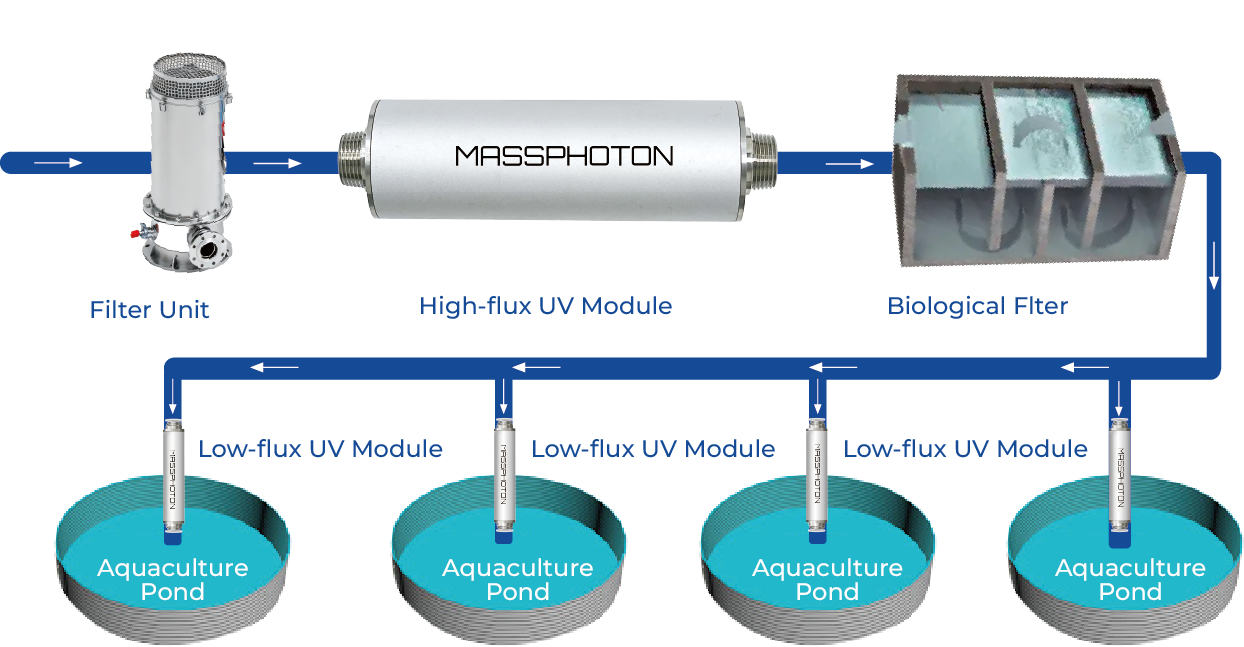
Clearest water quality: After mechanical filtration, biological filtration, and degassing, solid particles and organic matter concentrations are lowest, providing the highest UV transmittance (UVT >85%), ensuring effective UVC light penetration for microbial inactivation.
Protection of beneficial bacteria: Placing UV before the biofilter would kill nitrifying bacteria and destabilize the biological filter.
Efficient pathogen control: Recirculated water passes through UV repeatedly, achieving cumulative dosage for precise control of planktonic bacteria, viruses, and parasites without affecting the fish.
No interference with oxygen: UV does not consume dissolved oxygen, and installation after oxygenation allows direct return of disinfected, high-oxygen water to the tanks.
Biosecurity: Effectively inactivates Vibrio, heterotrophic bacteria, viruses (e.g., IHN, IPN), reducing disease outbreak risks.
Water quality stability: Controls total bacterial counts, reduces off-flavor compounds (geosmin, MIB), and improves fish flesh quality.
Cost-effectiveness: No chemical residues, simple maintenance (regular lamp replacement and quartz sleeve cleaning), low long-term operating costs.
Cost-Efficiency Comparison of UV with Other Methods
Compared to ozone: UV has lower initial/operating costs in continuous recirculation; no gas handling risks.
Compared to chemicals (peracetic acid/H₂O₂): No ongoing procurement/storage; avoids development of resistance.
Hybrid (UV + ozone): Suitable for high-end needs, but many cost-sensitive operations can rely solely on UV.
Traditional low-pressure mercury lamps: Mercury-free and fully compliant with the EU mercury lamp ban, eliminating hazardous waste disposal risks.
In the context of global water scarcity, increasingly stringent environmental regulations, and surging consumer demand for green aquaculture products, modular UVC LED disinfectors are not merely replacements for traditional mercury lamps—they are a key enabling technology for the transformation of RAS systems toward greater safety, efficiency, and sustainability.
For aquaculture enterprises and engineering firms pursuing long-term stable operations, cost optimization, and regulatory compliance, early adoption of UVC LED technology will significantly enhance system competitiveness, reduce operational risks, and lay a solid foundation for future higher-density, more intelligent industrial-scale aquaculture.


