1. Qi Cui, H.L.H.Y. and Z.C.H.H. Yun Lu, Bacterial removal performance and community changes during advanced treatment process: A case study at a full-scale water reclamation plant. Science of The Total Environment, 2020. 705.
2. Irene Carra, J.F.L., A.J.R.B. Olivier and Peter Jarvis, Disinfection by-product formation during UV/Chlorine treatment of pesticides in a novel UV-LED reactor at 285 nm and the mitigation impact of GAC treatment. Science of The Total Environment, 2020. 712.
3. Irene Carra, J.F.L.S., M.G. Scott Johannesen and P.J.S.J. Emma H. Goslan, Sorptive removal of disinfection by-product precursors from UK lowland surface waters: Impact of molecular weight and bromide. Science of The Total Environment, 2021. 754.
4. Cortés C, M.R., Genotoxicity of disinfection byproducts and disinfected waters: A review of recent literature. Mutat Res Genet Toxicol Environ Mutagen, 2018. 831: p. 1-12.
5. Richardson S D, P.C., Drinking water disinfection by-products[M]//Emerging organic contaminants and human health. Berlin, Heidelberg: Springer Berlin Heidelberg, 2011: p. 93-137.
6. Pelayo D, H.A.S.G., Performance of high-efficiency UVC LEDs in water disinfection: Experimental, life cycle assessment, and economic analysis of different operational scenarios. J Environ Manage, 2024(364:121442).
7. UNEP, U.N.E.P., Minamata Convention on Mercury: Text and Annexes. 2013.
8. Song K, T.F.M.M., Microorganisms inactivation by wavelength combinations of ultraviolet light-emitting diodes (UV-LEDs). Sci Total Environ, 2019: p. 665:1103-1110.
9. Sinha R P, H.D.P., UV-induced DNA damage and repair: a review. Photochemical & Photobiological Sciences, 2002. 4: p. 225-236.
10. Pattison DI, R.A.D.M., Photo-oxidation of proteins. Photochem Photobiol Sci, 2012. 1: p. 38-53.
11. Bennett JL, M.S., et al., Photolysis at the Speed of Light: Chemical-Free Degradation of Trace Organic Contaminants by Bespoke Photolysis Using High-Intensity Ultraviolet C Light-Emitting Diodes. ACS ES T Water, 2025. 11(5): p. 6375-6387.
12. Stella G. Michael, I.M.S.N., et al., Investigating the impact of UVC/H2O2 and sunlight/H2O2 on the removal of antibiotics, antibiotic resistance determinants and toxicity present in urban wastewater. Chemical Engineering Journal, 2020. 388.
13. Colleen Bowker, A.S. and J.D. Max Shatalov, Microbial UV fluence-response assessment using a novel UV-LED collimated beam system. Water Research, 2011. 45(5): p. 2011-2019.
14. Song K, M.M.T.F., Application of ultraviolet light-emitting diodes (UV-LEDs) for water disinfection: A review. Water Res, 2016(94:341-349).
15. Würtele MA, K.T.L.M., Application of GaN-based ultraviolet-C light emitting diodes--UV LEDs--for water disinfection. Water Res, 2011(45(3):1481-9).
16. Kheyrandish A, M.M.T.F., Development of a method for the characterization and operation of UV-LED for water treatment. Water Res, 2017(122:570-579).
17. Standards, C., GB 28235-2020. Hygienic requirements for ultraviolet appliance of disinfection, GB Hygienic Requirements For Ultraviolet Appliance Of Disinfection S Beijing China Standards Press, Edito. 2020.
18. Standardization, G.I.O.F., ISO 6222:1999. Water quality-Enumeration of culturable micro-organisms-Colony count by inoculation in a nutrient agar culture medium. 1999.
19. WHO, Guidelines for drinking-water quality: fourth edition incorporating the first and second addenda. 2022, Geneva: WHO.


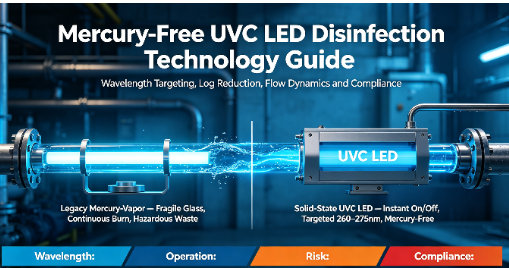 Upgrade to mercury-free UV disinfection. Discover how solid-state UVC LEDs eliminate toxic hazards, slash energy costs, and ensure compliance.
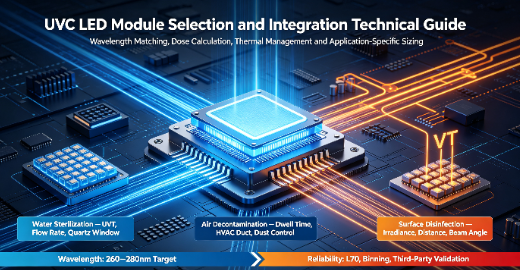 Master UVC LED module integration for sterilization. Optimize radiant flux, thermal management, and peak wavelengths to build reliable hardware.
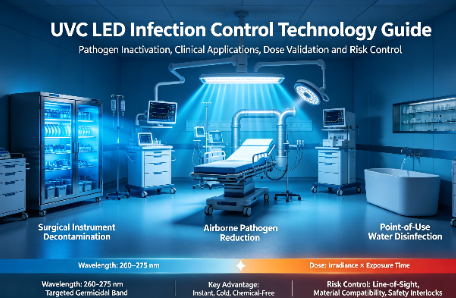 Eliminate healthcare sterilization bottlenecks with UVC LEDs. Discover rapid, mercury-free decontamination solutions for modern infection control.
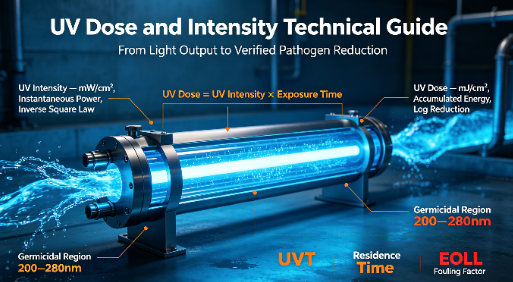 Stop buying UV systems based on raw power. Learn the critical difference between UV dose and UV intensity to guarantee microbial inactivation.
