Author: Site Editor Publish Time: 02-12-2025 Origin: Site


Recirculating water systems are widely used in industrial cooling, aquaculture, and central air-conditioning, where water quality management is critical to ensuring efficient and safe system operation. Water quality deterioration typically results from microbial growth, leading to biofouling, equipment corrosion, and potential pathogenic risks. Ultraviolet (UV) disinfection technology, known for its high efficiency, broad-spectrum antimicrobial performance, and chemical-free operation, has become an important means of controlling microbial proliferation.
Although traditional low-pressure mercury lamps are technologically mature, they suffer from inherent limitations such as mercury pollution, long warm-up times, and shortened lifespan under frequent on/off cycles. These drawbacks constrain their adoption in modular, intelligent system architectures.
UVC-LED technology has emerged as a promising alternative with advantages including compact size, instant response, and mercury-free environmental safety. However, its long-term operational stability remains a key challenge, primarily due to optical power degradation over time (“light decay”), which directly weakens the effective disinfection dose. Therefore, a systematic exploration of the principles governing long-term stability is essential for advancing UVC-LED technology from laboratory trials to large-scale engineering applications.
Current mainstream UVC-LEDs are based on AlGaN material systems. Their optical degradation stems from the dynamic evolution of crystal defects (such as dislocations and point defects) under high current density and elevated temperatures. These defects act as non-radiative recombination centers, reducing internal quantum efficiency (IQE), and may further induce localized electromigration or phase separation, resulting in irreversible power loss.
Quantum well structure optimization
Studies show that strain-compensated multiple quantum wells (MQWs) effectively suppress carrier leakage and Auger recombination, enhancing stability under high-current operation. Compared with single quantum wells, MQW structures can reduce optical output decay by approximately 20% after 1,000 hours of continuous operation. This improvement is attributed to better stress distribution and reduced defect density caused by lattice mismatch, ultimately maintaining higher IQE.
UV-resistant packaging materials
High-energy UVC photons (>4.4 eV) can cause chain scission and yellowing in organic packaging materials such as silicone or epoxy resins. Experiments show that commercial silicone exhibits a transmissivity drop to below 65% after 5,000 hours of exposure to 265 nm UVC radiation. In contrast, devices packaged with fused quartz or fluorinated ethylene propylene (FEP) can maintain transmissivity above 92%.
Selecting highly UV-resistant packaging materials is therefore crucial for extending LED lifespan.
UVC-LEDs typically have electro-optical conversion efficiencies below 5%, meaning over 95% of electrical energy is converted into heat. Junction temperature (Tj) is a decisive factor affecting device lifetime.
Relationship between junction temperature and lifetime
Accelerated aging tests confirm that UVC-LED lifetime (L70, the time until optical power drops to 70% of initial output) decreases exponentially with rising junction temperature. When Tj increases from 60°C to 90°C, L70 may drop from 12,000 hours to below 4,000 hours. This is due to accelerated defect migration and material degradation at high temperatures.
Optimizing the thermal path
The heat conduction path follows: chip → solder layer → substrate → heat sink.
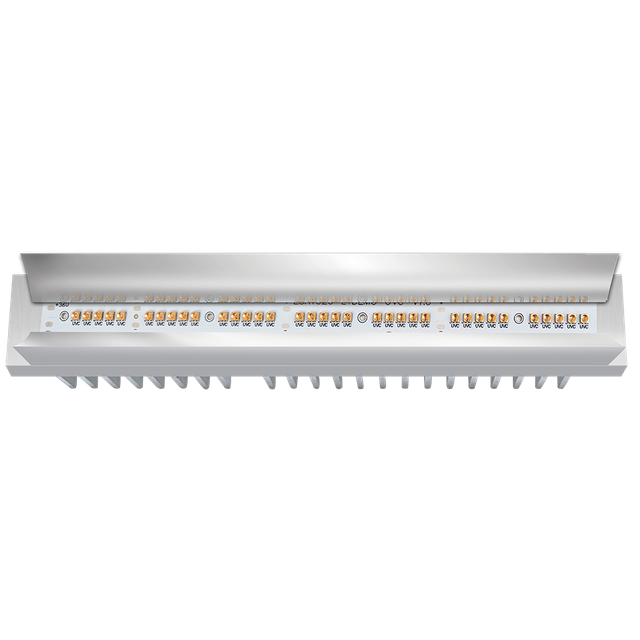
Using high-thermal-conductivity aluminum nitride (AlN) ceramic substrates (>170 W/m·K) significantly reduces thermal resistance. In recirculating water systems, integrating the LED module into the water channel wall allows water flow to directly cool the heat sink, keeping Tj below 65°C.
Experimental data show that forced water cooling reduces the light decay rate by about 50% compared with natural convection cooling.
This design effectively utilizes water’s high specific heat capacity to achieve passive, high-efficiency heat dissipation.
UVC disinfection performance depends on the effective dose (mJ/cm²) received by microorganisms. Turbidity, UV254 absorbance, and suspended solids in recirculating water greatly weaken UVC penetration.
Ultraviolet transmittance (UVT) requirements
In engineering practice, UVT at 254 nm (1 cm path length) should be no less than 85%.
When UVT drops to 70%, the required UVC intensity must increase by approximately 1.5× to achieve the same disinfection dose. Turbidity control is especially critical, as high turbidity (>1 NTU) leads to enhanced scattering.
System design strategies
Installing a 5–10 μm fine filter upstream of the UVC-LED reactor helps maintain low turbidity; optimizing the flow channel using computational fluid dynamics (CFD)—such as with helical flow or turbulence promoters—can raise dose uniformity to over 92%, eliminating short-circuiting or dead zones.
These measures ensure uniform irradiation and stable disinfection performance.
The instant-response nature of UVC-LEDs enables advanced intelligent control strategies.
Pulsed driving and on-demand disinfection
Studies show that using a 10 Hz pulsed mode with 50% duty cycle can reduce the average junction temperature by 12°C while maintaining equivalent microbial inactivation (e.g., >4-log E. coli reduction).
This operational strategy can extend L70 lifetime from 8,000 to over 12,000 hours (approx. 50% increase) by reducing thermal accumulation and suppressing optical degradation.
Temperature feedback control
By integrating PT100 sensors or thermistors to monitor substrate temperature in real time, and applying PID algorithms to regulate driving current, Tj fluctuations can be limited to ±2°C. This enhances long-term operational consistency.
The closed-loop feedback adapts to water quality variations and optimizes energy consumption.
Looking ahead, advancements in high-Al-content AlGaN epitaxy, low thermal resistance flip-chip packaging, and AI-driven water-quality–dose adaptive control will enable UVC-LEDs to achieve high reliability, long lifespan (>20,000 hours), and low energy consumption in recirculating water disinfection.
These innovations will accelerate the transition of recirculating water systems toward greener and more intelligent operation, contributing to sustainable development.
Step Toward Smarter, More Sustainable Water Treatment!
Is your industrial or commercial system struggling with inadequate water quality and the limitations of traditional disinfection? The stability and intelligence of UVC-LED technology represent the future.
Contact Our Engineering Team Today: Discuss how to integrate advanced, high-stability UVC-LED modules into your recirculating water system design for a long-lasting, highly efficient, and mercury-free disinfection solution.