The ubiquitous occurrence of antibiotics in aquatic environment has been widely recognized as a rising concern due to their environmental toxicity and the potential to induce antibacterial resistance genes. To remove antibiotics from water, UV AOP-based technologies have been proven to be effective. Of all antibiotics, sulfamethoxazole (SMX) has been widely studied and reported to be effectively removed by UV/H2O2 process (Borowska et al., 2015; Yang et al. 2017; Acosta-Rangel et al., 2018; Miklos et al., 2018; Zhu et al., 2019). All the studies mentioned above have only used low-pressure mercury lamps as the light source, leaving gaps in verifying the effectiveness of alternative light sources in applying UV AOP for contaminant removal. As an alternative to mercury lamps, Light-Emitting Diode (LED) that emits UVC has demonstrated efficiency in water/air disinfection with many advantages such as free of mercury (Scott et al., 2017). With the addition of hydrogen peroxide (H2O2), UVC-LED/H2O2 is expected to degrade SMX effectively at relatively low UV doses; yet its combination with UVC-LEDs has been barely reported. Therefore, this work aims to evaluate SMX degradation by UVC-LED/H2O2 in a flow-through UVC-LED reactor, with optimization of UV dose (controlled by flow rate and applied electrical current), and H2O2 dose under different conditions in terms of pH and water matrix at various initial SMX concentrations. UV-only treatments are also conducted as controls to UVC-LED/H2O2 to demonstrate its effectiveness.
A UVC-LED reactor that is commercially available (MASSPHOTON, Hong Kong) and capable of a flow rate of 24 Litre per minute will be used in this work. The average UV fluence of the reactor is characterized using ferrioxalate actinometry (Rabani et al., 2021). H2O2 concentrations are determined using titanium (IV) oxysulfate colorimetry (Sellers, 1980). SMX concentrations are determined using a Cary 60 UV-Vis spectrophotometer. The effluent from the LED reactor will be sampled at regular time steps to monitor H2O2 and SMX concentrations, which enable calculations of the pseudo-first-order removal rate and steady state parameters of the system. Eventually, a response surface model will be developed to evaluate the optimal dose of UV and H2O2 for SMX degradation with given system parameters.
This work will fill the research gap on UVC-LED-driven UV/H2O2 for SMX and will provide dose–response data that allow us to systematically evaluate the impact of system parameters on the removal of SMX. The ultimate outcome is to support mercury-free, energy-efficient LED AOPs for micropollutant removal from water and wastewater.
References
Borowska, E., Felis, E., & Miksch, K. 2015 Degradation of Sulfamethoxazole Using UV and UV/H2O2 Processes. Journal of Advanced Oxidation Technologies, 18, 69 - 77. https://doi.org/10.1515/jaots-2015-0109
Yang, Y., Lu, X., Jiang, J., Ma, J., Liu, G., Cao, Y., Liu, W., Li, J., Pang, S., Kong, X., & Luo, C. 2017 Degradation of sulfamethoxazole by UV, UV/H₂O₂ and UV/persulfate (PDS): Formation of oxidation products and effect of bicarbonate. Water Research, 118, 196 207. https://doi.org/10.1016/j.watres.2017.03.054
Acosta Rangel, A., Sánchez Polo, M., Polo, A. M. S., Rivera Utrilla, J., & Berber Mendoza, M. S. 2018 Sulfonamides degradation assisted by UV, UV/H₂O₂ and UV/K₂S₂O₈: Efficiency, mechanism and byproducts cytotoxicity. Journal of Environmental Management, 225, 224 231. https://doi.org/10.1016/j.jenvman.2018.06.097
Miklos, D. B., Hartl, R., Michel, P., Linden, K. G., Drewes, J. E., & Hübner, U. 2018 UV/H₂O₂ process stability and pilot scale validation for trace organic chemical removal from wastewater treatment plant effluents. Water Research, 136, 169 179. https://doi.org/10.1016/j.watres.2018.02.044
Zhu, G., Sun, Q., Wang, C., Yang, Z., & Xue, Q. 2019 Removal of Sulfamethoxazole, Sulfathiazole and Sulfamethazine in their Mixed Solution by UV/H2O2 Process. International Journal of Environmental Research and Public Health, 16(10), 1797. https://doi.org/10.3390/ijerph16101797
Rabani, J., Mamane, H., Pousty, D. and Bolton, J.R. 2021 Practical Chemical Actinometry—A Review. Photochem Photobiol. 97, 873-902. https://doi.org/10.1111/php.13429
Sellers, R. M. 1980. Spectrophotometric determination of hydrogen peroxide using potassium titanium(IV) oxalate. Analyst. 105 (1255), 950–954. https://doi.org/10.1039/AN9800500950
Scott, R., Mudimbi, P., Miller, M.E., Magnuson, M., Willison, S., Phillips, R. and Harper, W.F., Jr. 2017 Advanced Oxidation of Tartrazine and Brilliant Blue with Pulsed Ultraviolet Light Emitting Diodes. Water Environment Research, 89, 24-31. https://doi.org/10.2175/106143016X14733681696167


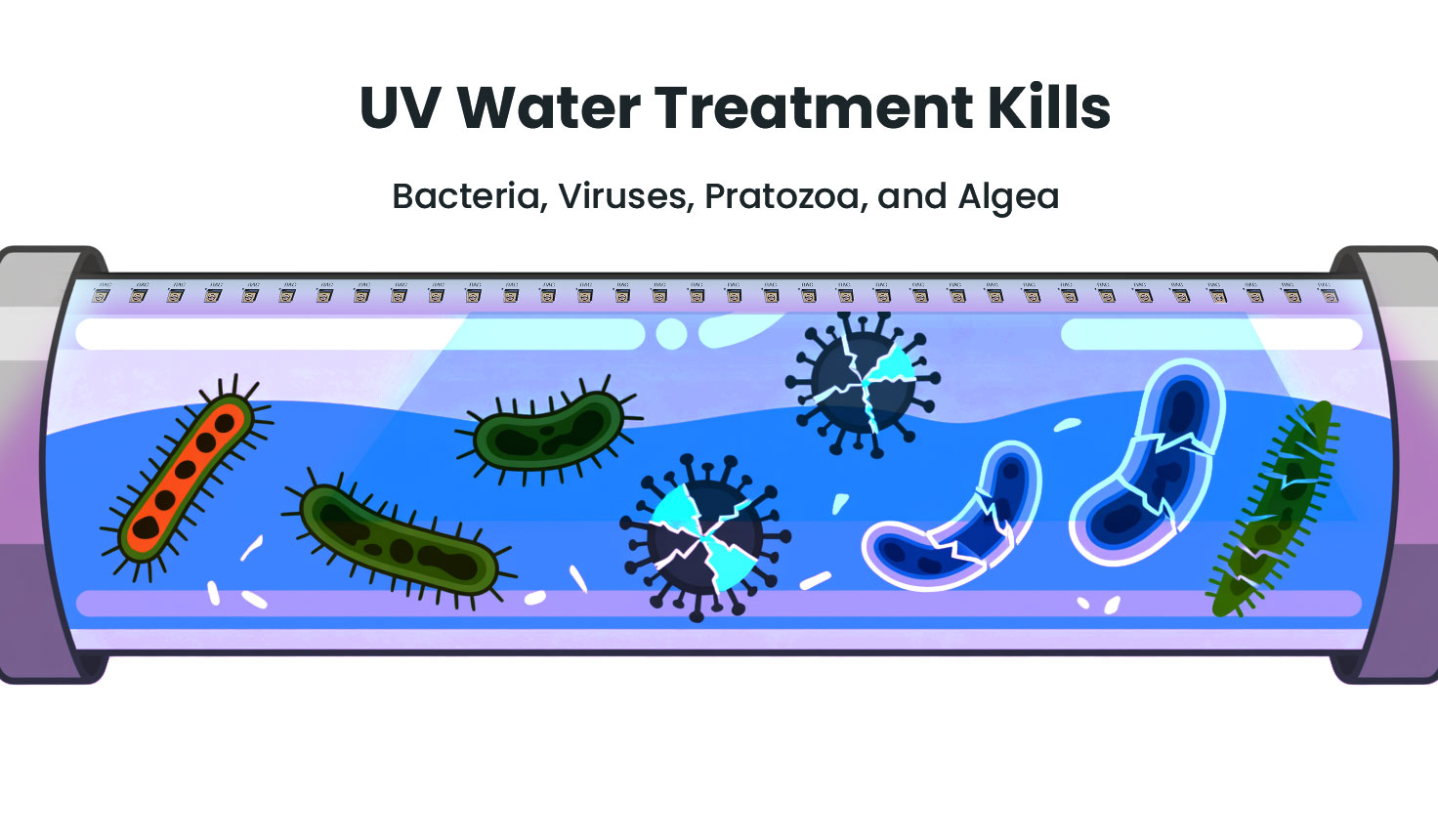 UV water treatment is a safe, chemical-free method that effectively kills bacteria, viruses, protozoa, and algae, ensuring clean and pathogen-free water.


