
Author: Site Editor Publish Time: 29-05-2026 Origin: Site


The global shortage of water resources and increasing concerns over water quality have made the upgrading of water disinfection technologies a critical component of public health protection. Although traditional low-pressure and medium-pressure mercury lamps are widely used, they suffer from inherent drawbacks such as mercury pollution, short lifespan, and slow start-up, making them inadequate for modern demands of green, efficient, and intelligent water treatment. UV-C LEDs, based on AlGaN epitaxial materials, emit radiation primarily in the 260–280 nm germicidal range. With advantages including mercury-free operation, instant on/off capability, compact size, and high spectral purity, they have become a research hotspot in water disinfection.
Existing studies indicate that the optoelectronic performance and long-term reliability of UV-C LEDs are highly sensitive to temperature. Due to their low external quantum efficiency, approximately 95% of the input electrical energy is converted into heat, leading to increased junction temperature and forming a vicious cycle of “junction temperature rise → efficiency drop → increased heat generation.” In water treatment scenarios, fluctuations in water temperature and device self-heating directly affect the operating state of UV-C LEDs, thereby influencing the precision and stability of disinfection.
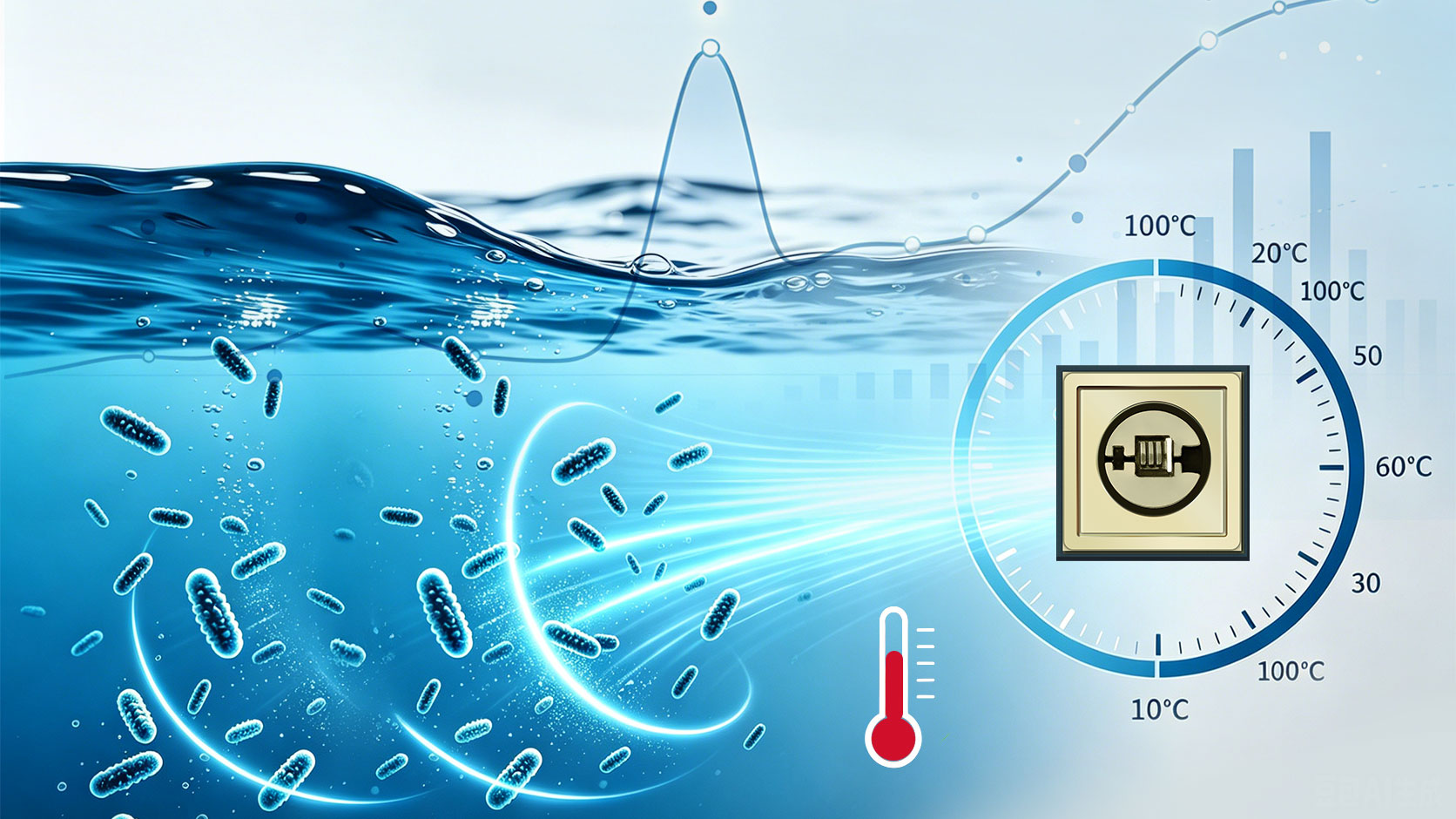
The disinfection mechanism of UV-C LEDs is essentially the inactivation of microorganisms mediated by photochemical damage. This process relies on the interaction between specific UV wavelengths and microbial nucleic acids. UV-C radiation in the 260–280 nm range is strongly absorbed by purine and pyrimidine bases in DNA/RNA, leading to covalent bond disruption and structural modification of nucleic acids . The most prominent damage forms are cyclobutane pyrimidine dimers (CPDs) and 6-4 photoproducts. These lesions form when adjacent pyrimidine bases bond covalently, hindering DNA unwinding and replication, inhibiting gene transcription and protein synthesis, and ultimately causing loss of microbial viability .
Disinfection efficiency varies with wavelength: 265 nm aligns closely with the DNA absorption peak, resulting in the strongest DNA damage potential; 280 nm can inhibit microbial photoreactivation and dark repair mechanisms, reducing the probability of damage repair. This wavelength specificity provides a foundation for precise disinfection.
Efficient water disinfection requires sufficient radiation intensity, appropriate exposure time, and stable spectral characteristics. The output power and spectral stability of UV-C LEDs directly determine the accuracy of the disinfection dose:
Disinfection dose (mJ/cm²) = Radiation intensity (mW/cm²) × Exposure time (s)
Different microorganisms require different lethal doses.
Temperature does not directly affect microorganisms but indirectly impacts disinfection by altering UV-C LED optoelectronic performance, including radiation intensity, spectral characteristics, and long-term stability. Key parameters such as output power, spectral behavior, and lifetime exhibit significant temperature dependence.
Output power is a core determinant of disinfection efficiency. Its temperature dependence mainly arises from enhanced non-radiative recombination and carrier overflow. As temperature increases, carrier thermal motion intensifies within AlGaN quantum wells, increasing non-radiative recombination probability and reducing radiative recombination. Additionally, higher temperatures exacerbate carrier overflow from quantum wells, lowering external quantum efficiency and leading to output power degradation.
Lifetime is a critical parameter for engineering applications, and it is negatively correlated with temperature. When the heat sink temperature increases from 25°C to 75°C, the lifetime of UV-C LEDs can decrease by 11–17 times. Under high current conditions (e.g., 350 mA), temperature-accelerated degradation becomes more pronounced .
After aging, the temperature dependence worsens; for example, the power temperature coefficient may degrade from −0.5%/°C to −0.6%/°C, indicating reduced thermal stability and increased fluctuation in long-term disinfection performance. Elevated temperatures also accelerate hydrogen migration in AlGaN materials, breaking Mg–H and N–H bonds and generating new point defects, which enhance non-radiative recombination. Simultaneously, packaging material degradation increases thermal resistance, further deteriorating device performance .
The disinfection efficiency of UV-C LEDs ultimately depends on the match between output power, spectral characteristics, and microbial exposure dose. Temperature influences these factors by modulating device performance.
Since output power decreases with increasing temperature, the actual disinfection dose under the same exposure time may become insufficient. In high water temperature scenarios, compensation strategies such as extending exposure time or increasing drive current are required. However, higher current further raises junction temperature and accelerates aging, necessitating a balance between efficiency and lifetime.
Over prolonged operation, temperature-induced degradation leads to continuous output power decline, affecting system stability. Under high-temperature conditions, the power degradation rate increases significantly, and L70 lifetime may decrease from over 10,000 hours to below 4,000 hours. This results in insufficient disinfection dose over time, requiring periodic maintenance or replacement. Thermal management strategies, such as heat dissipation modules and pulsed driving, can reduce junction temperature, slow degradation, and extend system lifespan.
Based on the temperature dependence of UV-C LED performance and disinfection efficiency, the following optimization strategies are proposed for water treatment scenarios:
For high-power disinfection modules, integrate micro-fans, liquid cooling plates, or thermoelectric coolers (TEC) to maintain heat sink temperature within 25–40°C and prevent junction temperature from exceeding 60°C. Separate UV-C LED modules from water flow channels and design independent airflow paths to minimize the impact of water temperature. Maintain a spacing of 10–15 mm between modules to enhance airflow efficiency.
For cold water (<20°C), reduce drive current to minimize heat generation. For warm water (30–60°C), adopt a combination of higher current and extended exposure time to compensate for power loss, while limiting single-device power consumption to less than 2 W to avoid excessive junction temperature. Integrate temperature sensors to monitor heat sink and junction temperature in real time, enabling closed-loop control of drive current and cooling systems to maintain optimal operating conditions.
Temperature is a critical factor influencing UV-C LED performance. Increased temperature leads to linear output power degradation and significantly reduced lifetime, while spectral changes, though moderate, still affect disinfection performance. This temperature dependence indirectly impacts the achievement of disinfection dose and long-term sterilization efficiency. High-temperature conditions can result in insufficient dosing and accelerated device aging, limiting large-scale application.
Current thermal management approaches, including flip-chip packaging, high thermal conductivity materials, active cooling, and pulsed operation, effectively reduce junction temperature and improve reliability. Future developments will focus on integrated, efficient, and cost-effective thermal management solutions, combining optimized designs, intelligent monitoring, and advanced materials to overcome high-temperature challenges and promote the widespread application of UV-C LED water disinfection technologies.
References:
1. Song K, M.M.T.F., Application of ultraviolet light-emitting diodes (UV-LEDs) for water disinfection: A review. Water Res, 2016(94:341-349).
2. Song K, T.F.M.M., Microorganisms inactivation by wavelength combinations of ultraviolet light-emitting diodes (UV-LEDs). Sci Total Environ, 2019: p. 665:1103-1110.
3. Sinha R P, H.D.P., UV-induced DNA damage and repair: a review. Photochemical & Photobiological Sciences, 2002. 4: p. 225-236.
4. Pattison DI, R.A.D.M., Photo-oxidation of proteins. Photochem Photobiol Sci, 2012. 1: p. 38-53.
5. Onushkin G, R.J. and E.A. Piva F, Efficiency-and lifetime-limiting effects of commercially available UVC LEDs: a review. Journal of Physics: Photonics, 2025. 3(7): p. 032002.
6. Trivellin N, F.D. and P. F, Reliability of commercial UVC LEDs: 2022 state-of-the-art. Electronics, 2022. 5(11): p. 728.
7. Shen CH, Y.R., et al., Optical power degradation mechanisms in 271 nm AlGaN-based deep ultraviolet light-emitting diodes. Opt Express, 2023. 12(31): p. 20265-20273.


