Author: Site Editor Publish Time: 17-08-2026 Origin: Site


In ultraviolet disinfection applications for whole-house water purification and household water purification terminals (e.g., under-sink water purifiers, water dispensers, whole-house water purification systems), conventional equipment mostly adopts low-pressure mercury UV lamps. Largely lacking intelligent linkage control, these lamps need to be powered on 24 hours a day to maintain disinfection capacity, resulting in substantial invalid energy consumption and excessive space occupation. In contrast, UVC-LED supports frequent instantaneous start-stop operations, and frequent switching will not significantly accelerate light source attenuation. This paper aims to quantitatively compare electricity cost savings, space utilization and comprehensive benefits of the two technical solutions in household scenarios through intuitive data.
Parameters are defined below based on common operating conditions of household water purification terminals:
UVC-LED intelligent disinfection module: rated power 12 W. Equipped with water flow sensor linkage control; operates only during water intake. The average daily effective operating time is set at 2 hours.
Conventional low-pressure mercury UV lamp: rated power 36 W. Adopts traditional control logic without water flow linkage and runs continuously for 24 hours a day.
Parameters for general whole-house water purification operating conditions:
UVC-LED intelligent disinfection module: rated power 43 W. Equipped with water flow sensor linkage control; operates only during water intake. The average daily effective operating time is set at 2 hours.
Conventional low-pressure mercury UV lamp: Single low-pressure lamp has limited power. To meet the high flow rate of 48 L/min, multiple high-intensity lamps (e.g., four 100 W lamps or five 80 W lamps) must be arranged in parallel inside the reaction chamber. The total system input power is set at 400 W. Adopts traditional control logic without water flow linkage and runs continuously for 24 hours a day.
Electricity price standard: Tier 1 residential electricity price of 0.55 CNY/(kW·h).
Terminal water purification equipment such as under-sink machines and water dispensers feature low flow rates and low rated power. Nevertheless, the "permanent lighting" effect of conventional equipment still causes obvious energy waste. UVC-LED enables frequent instantaneous start-stop without notable light attenuation. By contrast, frequent startup and shutdown are prohibited for low-pressure mercury lamps; applying water flow linkage control will drastically shorten their service life. Hence, conventional solutions can only run continuously around the clock.
(1) Daily power consumption comparison
Daily power consumption of UVC-LED module: 12 W ÷ 1000 × 2 h = 0.024 kW·h
Daily power consumption of conventional mercury lamp: 36 W ÷ 1000 × 24 h = 0.864 kW·h
Daily electricity saved by UVC-LED: 0.864 kW·h − 0.024 kW·h = 0.840 kW·h
(2) Electricity cost saving calculation
Daily electricity cost saved: 0.840 kW·h × 0.55 CNY/kW·h = 0.462 CNY
Monthly electricity cost saved (30 days): 0.462 CNY × 30 = 13.860 CNY
Annual electricity cost saved (365 days): 0.462 CNY × 365 = 168.630 CNY
Whole-house water purification needs to satisfy simultaneous water demand at multiple household outlets, resulting in a high power base and an extremely prominent energy consumption gap between the two technologies.
(1) Daily power consumption comparison
Daily power consumption of UVC-LED module: 43 W ÷ 1000 × 2 h = 0.086 kW·h
Daily power consumption of conventional mercury lamp: 400 W ÷ 1000 × 24 h = 9.600 kW·h
Daily electricity saved: 9.600 kW·h − 0.086 kW·h = 9.514 kW·h
(2) Electricity cost saving calculation
Daily electricity cost saved: 9.514 kW·h × 0.55 CNY/kW·h = 5.233 CNY
Monthly electricity cost saved (30 days): 5.233 CNY × 30 = 156.990 CNY
Annual electricity cost saved (365 days): 5.233 CNY × 365 = 1908.950 CNY
Comparative data are summarized below to visualize energy-saving performance in both application scenarios.
Application Scenario | Equipment Type | Total System Power (W) | Average Daily Operating Hours (h) | Annual Power Consumption (kW·h) | Annual Electricity Cost Saved (CNY) | Energy Saving Ratio (%) |
|---|---|---|---|---|---|---|
Whole-house Water Purification (48 L/min) | Conventional Mercury Lamp Array | 400 | 24 | 3504.000 | – | – |
UVC-LED Module | 43 | 2 | 31.390 | 1908.950 | >99 | |
Terminal Water Purification (Low Flow Rate) | Conventional Mercury UV Lamp | 36 | 24 | 0.864 | – | – |
UVC-LED Module | 12 | 2 | 0.024 | 168.630 | >97 |
Whether for high-flow or low-flow applications, the core reason that UVC-LED solutions achieve an ultra-high energy saving rate of 97%~99% lies in eliminating approximately 22 hours of invalid standby energy consumption during nighttime and non-water-consuming periods of conventional equipment, enabling precise on-demand energy allocation. Although a single terminal device saves roughly 168 CNY in electricity costs per year, massive cumulative electricity savings and carbon emission reductions can be achieved through large-scale replacement, given the huge market inventory of household terminal water purification equipment.
Beyond energy consumption differences, substantial generational technical gaps exist between the two solutions in flow rate adaptability, daily treatment capacity stability and physical footprint.
Instantaneous flow adaptation: Both technologies can meet the conventional flow demand of 1.5~3.0 L/min for household terminal water purification.
Compliance rate of treatment effect: Conventional mercury lamps suffer preheating delays or uneven UV dosage immediately after startup or under low flow conditions. UVC-LED features nanosecond-level instant startup and delivers rated UV dosage the moment the tap is opened, avoiding incomplete disinfection of initial outflow water. Under the typical household daily water treatment volume (200–400 L/day), UVC-LED maintains a more stable dosage compliance rate under all flow and operating conditions.
Conventional mercury lamp (large footprint): Sufficient UV irradiation dosage requires guaranteed hydraulic retention time, leading to lengthy reaction chambers (20~40 cm). Extra space is also required for external ballasts and heat dissipation. The overall assembly is bulky, occupying limited under-kitchen-cabinet space and restricting pipeline layout.
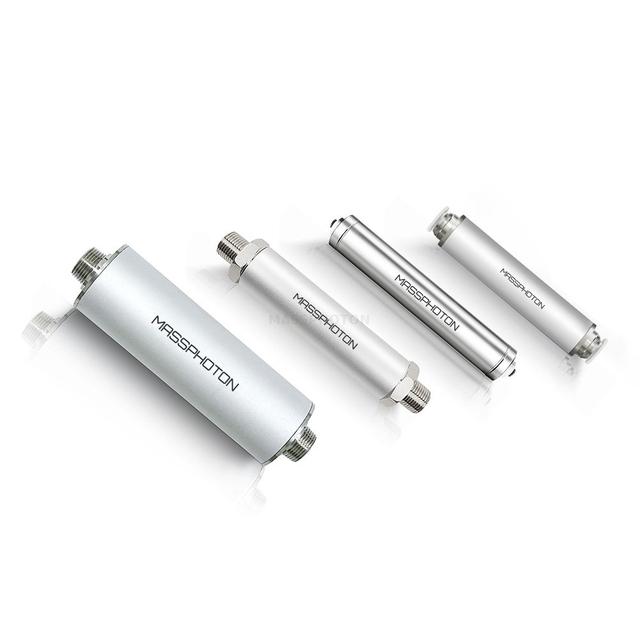
UVC-LED module (ultra-compact): Benefiting from high energy density and array layout of LED chips, equivalent or even higher UV dosage can be realized within an extremely short water channel chamber (5~10 cm). Its modular and miniaturized design can be seamlessly integrated into compact RO water purifiers or even built directly into water purification faucets. Overall space occupation is reduced by over 70% compared with conventional solutions, perfectly matching the trend of compact and integrated under-cabinet household water equipment.
Core driver of energy consumption disparity: Conventional mercury UV lamps generate massive standby energy consumption during nighttime or idle periods without water flow linkage. Equipped with a pulse-type water flow sensing intelligent control system, UVC-LED modules completely eliminate power waste during idle hours, which is the key to achieving an energy saving rate exceeding 97%.
Greatly reduced operation, maintenance and consumable costs: The service life of conventional mercury lamps is generally around 8,000 hours. Round-the-clock continuous operation accelerates wear and requires frequent replacement. UVC-LED boasts a theoretical service life exceeding 50,000 hours. The water-triggered on-off mode described in this case represents standard operating conditions; unlike frequent switching of traditional ballasts, it will not cause accelerated light attenuation, significantly lowering users’ long-term consumable replacement expenses.
Improved environmental performance and safety: Conventional mercury lamps contain liquid mercury, posing risks of heavy metal leakage once broken, which fails to meet stringent safety standards for modern household water purification. As solid-state light sources, UVC-LED contains no mercury, delivering superior environmental friendliness and operational reliability.
Featuring an energy saving rate above 97% and over 70% reduction in space occupation, intelligently controlled UVC-LED disinfection modules with automatic water flow start-stop deliver overwhelming comprehensive advantages over permanently lit conventional mercury UV lamps in household water purification scenarios, reshaping the technical paradigm of disinfection for domestic water treatment.
Microscopically, this solution generates tangible economic benefits for end users. Macroscopically, it aligns with China’s "Dual Carbon" strategy and green development initiatives. Large-scale popularization will bring exponentially amplified energy conservation and emission reduction effects, providing robust technical support for building a resource-conserving and environmentally friendly society. It demonstrates outstanding commercial value as well as far-reaching environmental and social significance.