Author: Site Editor Publish Time: 10-12-2025 Origin: Site


Core Summary:
Replacing low-pressure UV mercury lamps with UVC LEDs represents an industry upgrade driven by both "environmental regulations" and "technological performance." It is not only an inevitable choice in response to global mercury bans but also brings revolutionary breakthroughs in instant on/off capabilities, miniaturization, optical control, and system safety, opening up vast opportunities for product innovation. Although challenges remain in absolute efficiency and cost, the technology is advancing rapidly, making the replacement trend irreversible.
As technology continues to advance, many traditional methods are being replaced by more efficient and environmentally friendly new technologies. Among them, UV sterilization technology has undergone a shift from low-pressure UV mercury lamps to UVC LEDs. This change not only improves sterilization effectiveness but also brings higher safety and lower maintenance costs. So, why use UVC LEDs to replace low-pressure UV mercury lamps? This article will provide an in-depth analysis from multiple perspectives.
I. Environmental and Regulatory Mandates
The core flaw of traditional low-pressure UV mercury lamps lies in the mercury sealed inside them. This liquid metal, which evaporates at room temperature, is highly toxic to the human nervous system and causes long-term, widespread environmental pollution. If the lamp tube breaks, mercury vapor leaks, posing safety hazards.
With the deepening implementation of the global Minamata Convention on Mercury, the production and trade of mercury-containing products are strictly restricted. As a solid-state semiconductor light-emitting device, UVC LEDs fundamentally eliminate the use of mercury. They are essentially a "green light engine," preventing mercury pollution risks from the source and aligning closely with global Sustainable Development Goals (SDGs) and ESG (Environmental, Social, and Governance) evaluation systems—this is not just a compliance requirement but also a manifestation of corporate social responsibility.
In today's world where environmental protection is a hard threshold, UVC LEDs are not an "option" but a "necessity."
II. Disruptive Breakthroughs in Performance and Design
Beyond environmental attributes, UVC LEDs offer advantages in response speed, physical characteristics, optical efficiency, and system safety that bring unlimited possibilities to product design.
Instant On, Ready to Use Mercury lamps require high-voltage excitation of internal mercury vapor during startup, typically needing several minutes of preheating to reach rated output power, and must cool down after shutdown before restarting. In contrast, UVC LEDs, like ordinary LEDs, can achieve instantaneous on/off in milliseconds. This not only enables "on-demand sterilization," greatly saving energy, but also makes intelligent pulse sterilization possible. Through high-frequency switching modes, it can significantly extend device lifespan without sacrificing sterilization effectiveness.
Compact and Robust, Design Freedom Mercury lamps are delicate glass products that are bulky, fragile, and sensitive to vibration. UVC LEDs are small, compact, and durable. This physical advantage allows them to be easily integrated into spaces that were previously unimaginable: from portable disinfection boxes and smartwatch sterilizers to refrigerator interiors, air conditioning ducts, and water purifier faucets, unlocking unprecedented design freedom.
Precise Optics, Multiplied Efficiency UVC LEDs are surface light sources with small emission areas, making it easy to focus and direct light through micro-lenses. This means almost all UVC energy can be precisely projected onto the target area for sterilization. In contrast, tubular mercury lamps emit light in 360 degrees, wasting a lot of energy inside the system or absorbed by reflectors. Therefore, under the same input power, UVC LEDs often produce higher irradiance at the target point, resulting in higher sterilization efficiency.
Safe Low-Voltage, Stable and Reliable UVC LEDs use low-voltage DC drive, avoiding the high-voltage arcs required by mercury lamps and eliminating potential breakdown risks, making system electrical design simpler and usage safer.
III. Current Challenges and Rapidly Evolving Technological Reality
Admittedly, the full replacement of mercury lamps with UVC LEDs still faces three major real-world challenges, but each is being overcome at a faster-than-expected pace:
Electro-Optical Conversion Efficiency: Early UVC LEDs had low efficiency (1%-3%), far below mercury lamps (~35%). However, recent technological advancements have been rapid, with current commercial UVC LEDs reaching 5%-10% efficiency, and lab data even higher. Improved efficiency directly reduces heat dissipation needs and system power consumption.
Cost: Currently, achieving the same UVC output power makes UVC LEDs more expensive than mercury lamps. But as technology matures and production scales up, prices are dropping rapidly. From a total cost of ownership (TCO) perspective, considering longer lifespan, simpler drive, and cooling systems, the gap is narrowing.
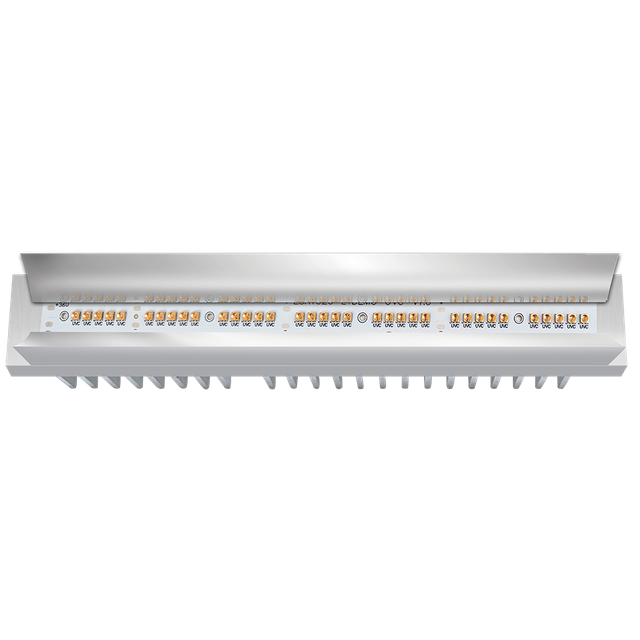
Power Density: The output power of a single UVC LED chip is still lower than that of a mercury lamp tube. However, for most point-based or distributed sterilization applications on surfaces, water, and air, multi-chip integration (COB packaging) and array designs can fully meet the requirements.
IV. Conclusion
Using UVC LEDs to replace low-pressure UV mercury lamps is an inevitable trend in technological development, driven by revolutionary breakthroughs in environmental protection, safety, and design. Although in specific fields like ultra-high-power industrial and municipal water treatment, low-pressure mercury lamps still hold a place due to their extremely high single-tube output power and low cost, in the vast majority of consumer electronics, home appliances, medical, commercial, and industrial applications, UVC LEDs have demonstrated overwhelming advantages and are rapidly becoming the new mainstream choice. As technology continues to advance and costs keep declining, UVC LEDs will ultimately fully replace UV mercury lamps, just as LED lights replaced incandescent and fluorescent lamps.